GEO’s Origins
WHERE IT ALL BEGAN
From an urgent community response to a province-wide movement
GEO Nova Scotia began with a simple realization: as more of daily life moved online, too many people were being left behind.
When the COVID-19 pandemic reached Nova Scotia in March 2020, access to a device and reliable home internet became essential almost overnight. Education, employment, healthcare, government services and social connections shifted online, but many Nova Scotians could not afford the technology required to participate.
In Dartmouth North, organizations connected through the Between the Bridges network were hearing the same concern from the people they supported: without internet access or an appropriate device, people were becoming increasingly isolated from services, opportunities and one another.
The need was immediate, and a collaborative response began to take shape.

History
Our history
2020 – 2026
The GEO Project begins
Within weeks, the GEO Project was established as a program of the Public Good Society of Dartmouth, with support from Between the Bridges and seed funding from United Way Halifax and Kiwanis Dartmouth.
Community organizations identified people who needed support. Private-sector partners helped provide affordable technology and connectivity. Funders contributed resources, and the GEO team coordinated the work.
By the end of 2020, the project and its partners had distributed 50 refurbished computers and provided free home internet to 40 households.
More importantly, the initiative demonstrated that a coordinated, partnership-based model could help remove barriers to digital access while creating a straightforward and supportive experience for participants.
Before the pandemic, I could access the internet at libraries and other public spaces. It made me feel like a second-class citizen. When that was taken away, I didn’t feel like a citizen at all.
GEO Connects Program Participant
Growing across Nova Scotia
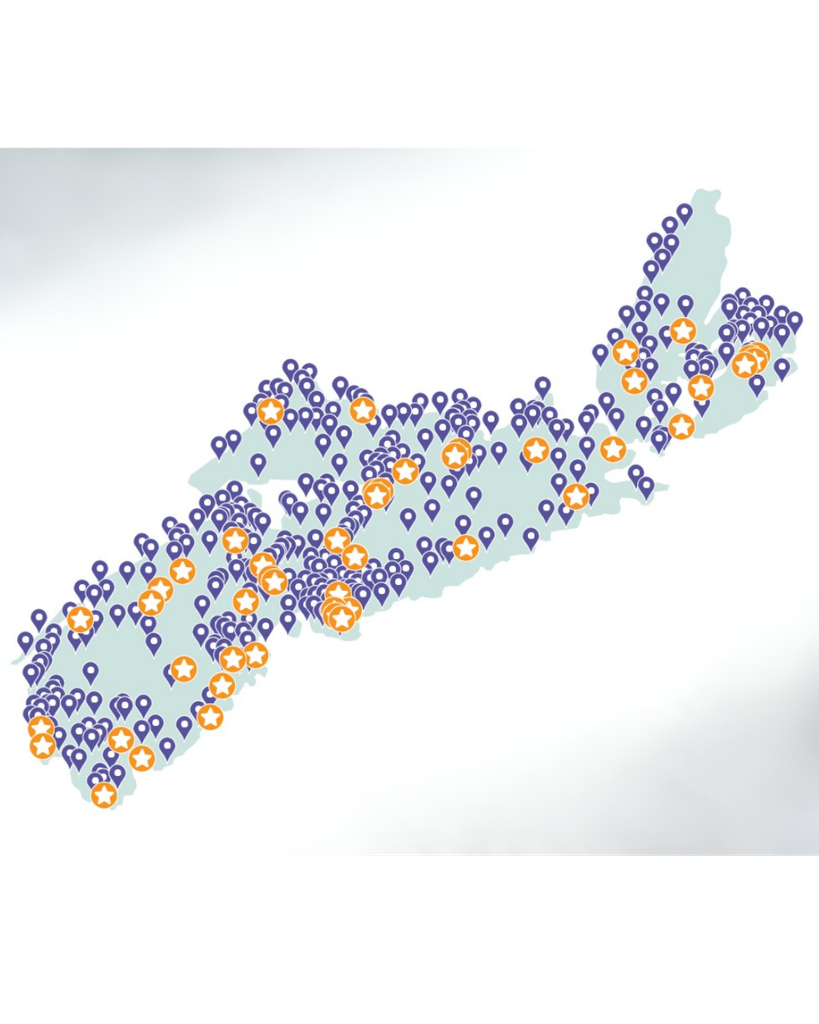
With investment from the Province of Nova Scotia and support from community and private-sector partners, the GEO Project expanded in 2021. Twelve-month pilot programs were launched in Halifax Regional Municipality, Cape Breton, the Annapolis Valley and the South West Shore.
Through a growing network of more than 75 Referral Partners, GEO connected over 350 households with one year of free high-speed internet and distributed more than 600 devices.
The model was also evaluated to better understand its processes, outcomes and potential for broader impact. Those early lessons helped establish the foundation for an independent, province-wide organization.
In March 2022, GEO Nova Scotia was formally registered as a nonprofit society, with founder Matt Spurway becoming its first Executive Director.
Built through collaboration
GEO was founded on two enduring ideas: digital inclusion must be available to everyone, and no organization or sector can achieve it alone.
This collaborative model was originally described within GEO as the “Stone Soup approach,” inspired by the idea that individual contributions can combine to create something much greater. Community organizations bring trusted relationships and local knowledge. Businesses provide technology, connectivity and expertise. Governments and funders contribute resources and support. Participants help GEO understand what works, what does not and where change is needed.
Today, that founding principle has evolved into a structured network of partnerships spanning the community, public and private sectors. It continues to shape how GEO develops programs, reaches communities and advances digital equity.

There are so many system barriers and service gaps that we’re often not able to support families to the extent that they need. Being able to provide this service to families through GEO has been wonderful.
— GEO Referral Partner

Inclusion in practice
From the beginning, GEO’s programs have been designed to reduce barriers and meet people where they are.
Our Referral Partners are central to this approach. These organizations already have trusted relationships with the people and communities they serve. Their knowledge helps GEO understand local needs, connect people with appropriate support and adapt programs when circumstances change.
Within our organization, we are committed to creating a respectful and welcoming environment for staff, partners and participants. We seek feedback, learn from lived and professional experience, and regularly review our practices to make our services more accessible and responsive.
We know this work requires continued learning. When something works, we build on it. When improvement is needed, we listen, adapt and move forward with greater understanding.
The next chapter
What began as a local response to an immediate crisis has grown into a province-wide organization working to improve quality of life through digital equity.
GEO now delivers multiple programs, works with organizations throughout Nova Scotia and contributes to broader conversations about the policies and systems needed to close the digital divide.
In 2025, GEO welcomed Bonnie Ste-Croix as its first Chief Executive Officer. Founder Matt Spurway transitioned from Executive Director to Chief Development Officer, focusing on partnerships and new opportunities for growth. Together, they are building on GEO’s founding vision and guiding the organization into its next chapter.
Today, GEO is strengthening its internal foundation, expanding its reach and building its capacity to become an established and influential voice for digital equity in Nova Scotia and beyond.
Our work has grown, but the principle behind it remains the same: lasting progress is made through collaboration.

“This opportunity gave me the freedom to work from home when things shut down again and still gives me the freedom to work from home on days I’m not well as I deal with a chronic illness that sometimes keeps me from leaving the house.”